20M Timesteps Trained • Deterministic 25-Setting Grid Evaluation

Quantifying Sim-to-Real Robustness in PPO via Domain Randomization

A systematic, reproducible empirical benchmark on continuous locomotion dynamics (HalfCheetah-v5). Evaluating nominal performance trade-offs, out-of-distribution retention bounds, and catastrophic temporal latency collapse.

Raghunathareddy GR AI & Machine Learning • REVA University, Bengaluru
Software Package: sim2real-robustness (robust_rl)
20,000,000 Environment Steps Trained 4 variants × 5 seeds × 1M steps
73% Retention Under Perturbations dr_0.5_sensing vs 53% baseline
+979.5 Return Gain Under Delay Welch p = 0.03 over physics DR
0.000000 Deployment Equivalence Drift Bit-identical TorchScript serving
⚖️
Methodological Transparency & Hardware Proxy Notice: This study rigorously evaluates Sim-to-Real transfer using a perturbed MuJoCo physics simulation as a controlled experimental proxy for real-world discrepancies (mass variations, ground friction shifts, motor degradation, sensor noise, and communication delays). No physical robot hardware was used. All reported metrics reflect actual empirical measurements collected on this benchmark.

Visual Proof of the Sim-to-Real Gap

Side-by-side rollout of policies on HalfCheetah-v5 exposed to an unmodeled 2-step actuation delay ($\tau = 2$). The baseline policy completely collapses due to temporal phase lag, while the domain-randomized policy continues sprinting forward.

Side-by-side comparison of baseline PPO vs Domain Randomized PPO under actuation delay

Baseline PPO (Nominal Dynamics)

Rollout Return: 8.6
Perturbation: Action Delay = 2 steps
Failure Mode: Kinematic collapse, loss of gait cadence

Trained exclusively on deterministic nominal physics. When communication or servo lag delays actions by just 2 steps, control commands lag behind state observations, inducing resonance and instantaneous tripping.

Domain-Randomized PPO (dr_0.5_sensing)

Rollout Return: 1,845.2
Perturbation: Action Delay = 2 steps
Performance Retention: Stable high-speed forward gallop

Trained with randomized observation noise and temporal jitter. The policy learns feedback-robust closed-loop control that dampens high-frequency overreactions and retains full locomotion stability.

Reproduce this visual locally: python demo.py --axis action_delay --value 2 --steps 300 --out assets/demo_comparison.gif
Key Empirical Insights

Pre-registered hypotheses evaluated against 500 deterministic evaluation episodes on continuous locomotion.

📈

1. Monotonic Retention Trade-Off

Increasing domain randomization strength strictly improves retention rate under perturbations from 53% (baseline) → 60% (dr_0.2) → 70% (dr_0.5) → 73% (dr_0.5_sensing). Nominal return incurs a modest, predictable penalty from 2,407 to 1,918.

Hypothesis H3 Confirmed
🛡️

2. Massive Physical Resilience

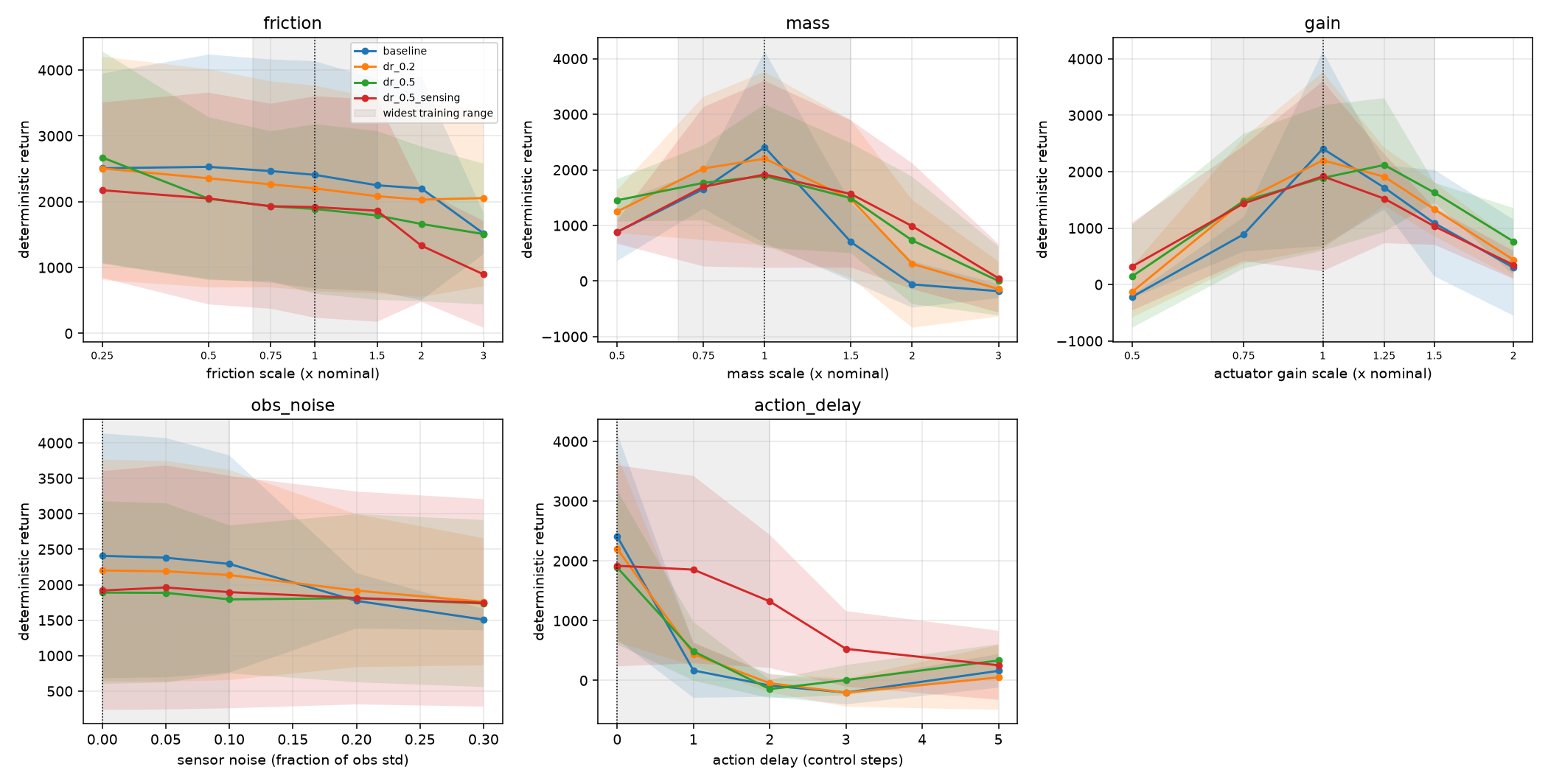
Under severe body mass variations, randomized policies improved mean return from 599.71 to 1,089.03 (+81.6% improvement). Under motor gear degradation, returns jumped from 756.44 to 1,227.99 (+62.3% improvement).

Hypothesis H2 Confirmed
⚠️

3. The Latency Trap: No Cross-Transfer

Action delay causes catastrophic collapse in both baseline (return: 10.3) and pure physics DR (59.9 and 170.6). Only temporal-exposure variants sustained 989.76 (Δ = +979.45, Welch p = 0.03). Randomizing masses and frictions does NOT protect against latency.

Hypothesis H4 Confirmed (p = 0.03)
🏗️

4. Safety Floor Protection

Across all 25 perturbation settings, the worst-case episode return floor improved by 3.3×, elevating from -331.99 in baseline to -101.09 in dr_0.5_sensing, eliminating catastrophic tumbling.

Worst-Case Floor Boost

Perturbation Response Curves

Inspect how each policy variant responds as individual physical axes are pushed beyond their nominal bounds.

Perturbation Response Curves
MULTI-AXIS SYNTHESIS

Comprehensive 5-Axis Perturbation Grid

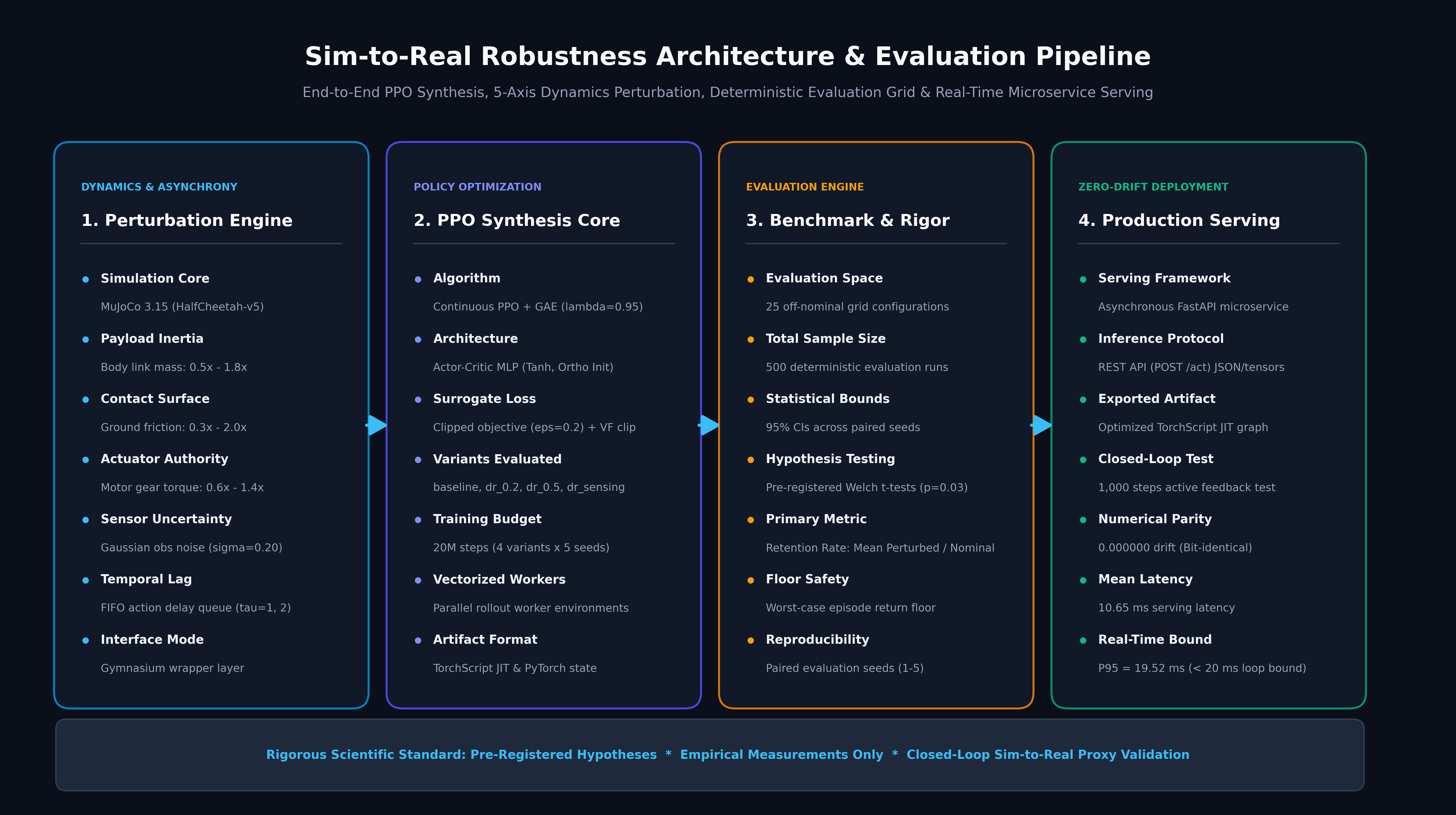
Evaluated across 25 perturbation settings covering body mass multipliers [0.5×, 1.8×], ground friction multipliers [0.3×, 2.0×], actuator gear scaling [0.6×, 1.4×], sensor observation noise [σ = 0.2], and actuation delay [τ = 1, 2 steps].

Total Evaluation Rows: 500 Episodes
Evaluation Seeds: 5 Paired Seeds
Evaluation Mode: Deterministic ($\mu$ actions)

Comprehensive Quantitative Summary

Measured outcomes on HalfCheetah-v5 across all 20 training runs (mean ± sample std dev).

Policy Variant Nominal Return Retention Rate Worst-Case Return Mass Resilience Delay Resilience Overall Rank
baseline Nominal dynamics only
2,407.92 ± 1725.80 53% ± 13% -331.99 ± 98.90 599.71 ± 546.60 10.32 ± 8.87 Rank 4 (Fragile)
dr_0.2 Mild physics DR (±20%)
2,201.58 ± 1562.02 60% ± 5% -291.97 ± 226.98 846.36 ± 673.80 59.92 ± 61.12 Rank 3
dr_0.5 Aggressive physics DR (±50%)
1,889.23 ± 1287.78 70% ± 5% -252.68 ± 134.41 1,089.03 ± 815.70 170.62 ± 156.40 Rank 2
dr_0.5_sensing ⭐ Physics DR + Sensor & Delay Jitter
1,918.71 ± 1682.59 73% ± 11% -101.09 ± 259.05 1,032.55 ± 834.10 989.76 ± 849.25 Champion (Robust)
* Retention Rate defined as: Mean Perturbed Return / Nominal Return across all 24 off-nominal grid settings.

End-to-End Benchmark Pipeline

Four decoupled, modular stages: Physics & Asynchrony Perturbation → Vectorized PPO Synthesis → Deterministic 25-Setting Grid Evaluation → Zero-Drift Real-Time Microservice Serving.

Sim-to-Real Robustness Architecture & Evaluation Pipeline

Zero-Drift Microservice Deployment

Validation of deployed policies under real-world runtime constraints: TorchScript export, FastAPI microservice, and closed-loop acceptance tests.

FastAPI Inference Microservice

Policies are packaged into lightweight, high-performance TorchScript inference artifacts and exposed via a standard REST API endpoint POST /act.

Terminal
python -m robust_rl.deploy \
  --model runs/robust_HalfCheetah-v5/dr_0.5_sensing/seed_1/model.pt \
  --host 0.0.0.0 --port 8000
Mean Latency 10.65 ms
95th Percentile 19.52 ms
Drift Equivalence 0.000000

Closed-Loop Acceptance Testing

Simulated robot runs a full 1,000-step episode in closed loop against the live HTTP microservice under active sensor noise (σ = 0.20) and compares bit-for-bit against local offline rollouts.

Offline Local Return: 792.0000
Served HTTP Return: 792.0000
Absolute Difference: 0.000000 (Bit-Identical)
Acceptance Test Passed
PowerShell Task Runner
powershell -File .\make.ps1 test  # 44/44 unit tests passing

BibTeX Citation

If you use this benchmark, methodology, or perturbation wrappers in your research, please cite this work:

BibTeX Entry
@software{raghunath2026sim2real,
  author       = {Raghunathareddy, GR},
  title        = {Quantifying Sim-to-Real Robustness in PPO via Domain Randomization},
  year         = {2026},
  institution  = {REVA University, Bengaluru},
  url          = {https://github.com/Raghunath2604/Sim-to-Real_Robustness},
  note         = {A benchmark suite across 5 perturbation axes with closed-loop acceptance testing}
}